
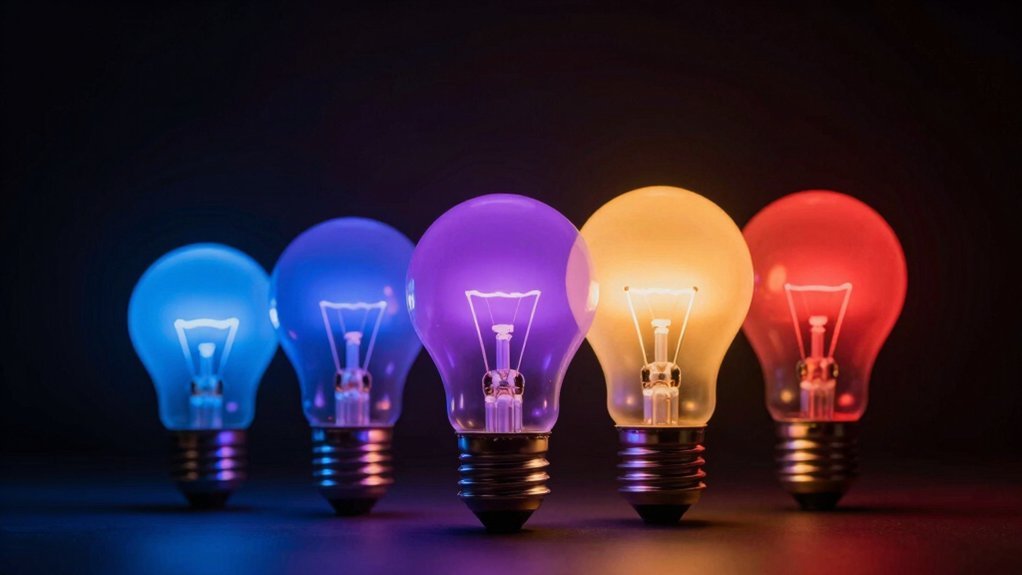
You’re probably wondering which grow bulbs’ll actually deliver results for your indoor garden. With so many options claiming full-spectrum benefits, you’ll want to know what separates the top performers from the rest. The right bulb can transform your growing season, but choosing poorly wastes money and stunts your plants. We’ve tested the leading contenders to find what really works.
| Briignite LED Grow Light Bulb A19 Full Spectrum (2-Pack) |  | Best for Beginners | Power Consumption & Equivalent Wattage: 11W (100W equivalent) | Light Output (Lumens/PPF): 1000 LM, PPF 25 μmol/s | Color Temperature: 4000K white | VIEW ON AMAZON | Read Our Analysis |
| Briignite LED Grow Light Bulbs Full Spectrum (3-Pack) |  | Best Value | Power Consumption & Equivalent Wattage: 11W (100W equivalent) | Light Output (Lumens/PPF): 1000 LM, PPF 25 μmol/s | Color Temperature: 3500K warm white | VIEW ON AMAZON | Read Our Analysis |
| SANSI 36W Full Spectrum LED Grow Light Bulb |  | Professional Grade | Power Consumption & Equivalent Wattage: 36W (400W equivalent) | Light Output (Lumens/PPF): PPF 65.6 μmol/s | Color Temperature: 4000K daylight | VIEW ON AMAZON | Read Our Analysis |
| SANSI 24W LED Grow Light Bulb BR30 |  | Best for Wide Coverage | Power Consumption & Equivalent Wattage: 24W (200W equivalent) | Light Output (Lumens/PPF): PPFD 126 μmol/s·m² at 1 ft | Color Temperature: 4000K daylight white | VIEW ON AMAZON | Read Our Analysis |
| Briignite Full Spectrum LED Grow Light Bulb (3-Pack) |  | Best Overall | Power Consumption & Equivalent Wattage: 11W (100W equivalent) | Light Output (Lumens/PPF): 1000 LM, PPF 25 μmol/s | Color Temperature: 5000K white | VIEW ON AMAZON | Read Our Analysis |
More Details on Our Top Picks
Briignite LED Grow Light Bulb A19 Full Spectrum (2-Pack)
If you’re tired of purple-tinted grow lights cluttering your home décor, the Briignite A19 offers a rejuvenating alternative. You’ll get a natural 4000K white appearance with integrated red and blue spectrum that mimics sunlight without the eyesore. This E26-compatible bulb delivers 1000 lumens—equivalent to a 100W incandescent—while consuming just 11W, saving you roughly 90% on electricity. The full-spectrum design supports all plant growth stages, from seed starting through fruiting. Its plastic and aluminum cooling system ensures low heat generation and extended lifespan. You simply screw it into any standard socket; no special fixtures required. For tomatoes, herbs, leafy greens, and more, you’ll enjoy professional-grade performance in a convenient, aesthetically pleasing package.
- Power Consumption & Equivalent Wattage:11W (100W equivalent)
- Light Output (Lumens/PPF):1000 LM, PPF 25 μmol/s
- Color Temperature:4000K white
- Bulb Type & Base:A19 bulb, E26 base
- Lifespan:Longer lifespan (unspecified hours)
- Heat Management Technology:Plastic & aluminum cooling system
- Additional Feature:180-degree beam coverage
- Additional Feature:Zero light pollution design
- Additional Feature:2-pack quantity included
Briignite LED Grow Light Bulbs Full Spectrum (3-Pack)
Looking to grow vegetables indoors without replacing your entire lighting setup? The Briignite 3-Pack LED Grow Light Bulbs fit standard E26 sockets, making installation effortless. You’ll get 1000 lumens per bulb with full-spectrum light that mimics natural sunlight, supporting tomatoes, peppers, and leafy greens through all growth stages. At 11 watts each, they consume significantly less energy than traditional 60-watt incandescent bulbs while delivering a 25,000-hour lifespan. The balanced wavelength provides 25 micromoles per second PPF for optimal plant absorption. With 180-degree coverage and a CRI of 90, you’re getting quality light that won’t break your energy bill. At 4.6 stars from over 3,000 reviews, these bulbs deliver proven results.
- Power Consumption & Equivalent Wattage:11W (100W equivalent)
- Light Output (Lumens/PPF):1000 LM, PPF 25 μmol/s
- Color Temperature:3500K warm white
- Bulb Type & Base:A19 bulb, E26 base
- Lifespan:Up to 25,000 hours
- Heat Management Technology:Plastic & aluminum materials
- Additional Feature:CRI 90 color rendering
- Additional Feature:50,000 hours lifespan option
- Additional Feature:3-pack quantity included
SANSI 36W Full Spectrum LED Grow Light Bulb
Want a grow light that delivers professional-grade performance without the professional-grade price tag? The SANSI 36W offers exactly that. Its patented ceramic heat sink technology outperforms traditional aluminum designs, conducting heat faster and boosting light efficiency. You’ll get a PPF of 65.6 umol/s with a 4000K full spectrum covering 400nm–780nm, supporting every plant growth stage. The secondary optical lens maximizes light distribution, while the low-IR output minimizes burn risks. With 25,000-hour longevity and ETL certification, you’re investing in reliable, safe supplementary lighting that genuinely improves yields and plant quality.
- Power Consumption & Equivalent Wattage:36W (400W equivalent)
- Light Output (Lumens/PPF):PPF 65.6 μmol/s
- Color Temperature:4000K daylight
- Bulb Type & Base:Standard screw-in bulb
- Lifespan:25,000 hours
- Heat Management Technology:Patented COc (Chip on Ceramic) technology
- Additional Feature:Patented COc ceramic technology
- Additional Feature:Secondary optical lens design
- Additional Feature:5-year protection plan
SANSI 24W LED Grow Light Bulb BR30
The SANSI 24W LED Grow Light Bulb BR30 stands out as the ideal choice for growers who need versatile, even coverage across multiple plants. You’ll appreciate its 120° wide beam angle, which distributes full-spectrum light uniformly across your canopy. With a PPFD of 126 μmol/s·m² at one foot, it supports plants throughout their entire life cycle while mimicking natural sunlight at 4000K. The innovative ceramic heat sink technology ensures reliable performance and faster heat dissipation. Its IP54 waterproof rating lets you use it indoors or outdoors confidently. Low infrared emission prevents plant burn, even at closer distances, making it an efficient, dependable option for diverse growing setups.
- Power Consumption & Equivalent Wattage:24W (200W equivalent)
- Light Output (Lumens/PPF):PPFD 126 μmol/s·m² at 1 ft
- Color Temperature:4000K daylight white
- Bulb Type & Base:BR30 form factor
- Lifespan:Not specified
- Heat Management Technology:Chip on Ceramic technology
- Additional Feature:120° wide beam angle
- Additional Feature:IP54 waterproof rating
- Additional Feature:BR30 form factor
Briignite Full Spectrum LED Grow Light Bulb (3-Pack)
If you’re tired of swapping between multiple bulbs for different plant growth stages, Briignite’s full spectrum LED option offers a streamlined solution. You’ll get three 11W bulbs that consume 90% less electricity than traditional 100W bulbs while delivering 1000 lumens across a 180-degree beam. The 5000K white light includes red and blue spectrums, simulating natural sunlight for tomatoes, peppers, leafy greens, and herbs. These bulbs fit standard E26 sockets without additional fixtures, and their aluminum construction dissipates heat effectively, extending lifespan to 25,000 hours. With a PPF of 25 micromoles per second, you’re investing in efficient, reliable plant growth.
- Power Consumption & Equivalent Wattage:11W (100W equivalent)
- Light Output (Lumens/PPF):1000 LM, PPF 25 μmol/s
- Color Temperature:5000K white
- Bulb Type & Base:A19 bulb, E26 base
- Lifespan:Up to 25,000 hours
- Heat Management Technology:Plastic & aluminum for cooling
- Additional Feature:Purple/red tint elimination
- Additional Feature:25,000 hours lifespan
- Additional Feature:3-pack quantity included
Factors to Consider When Choosing Full Spectrum Grow Bulbs
When selecting a full spectrum grow bulb, you’ll want to evaluate the light spectrum quality to ensure it matches your plants’ growth stage, compare energy efficiency ratings to minimize your electricity costs, and assess the brightness and output levels your specific setup requires. You should also examine the heat management systems in place, as excessive heat can damage plants and waste energy, while considering the bulb’s lifespan duration to determine long-term value and replacement frequency. These factors work together to help you choose the most effective and economical option for your growing needs.
Light Spectrum Quality
How do you know if a full spectrum grow bulb will actually deliver the light your plants need? You’ll want to check the color temperature—aim for 4000K–5000K white light combined with added red and blue wavelengths that support all growth stages.
Look for a CRI (Color Rendering Index) near 90–100, which means the lighting closely resembles natural sunlight. This accuracy helps you assess your plants’ health more effectively.
Next, examine the PPF and PPFD values. A bulb delivering around 25 micromoles per second PPF or approximately 265 μmol/s/m² PPFD at 1 foot demonstrates efficient photosynthetic light delivery.
Finally, consider beam coverage—360-degree or 180-degree designs with optimized lens or optical systems ensure even light distribution across your canopy.
Energy Efficiency Ratings
Now that you’ve assessed your bulb’s light quality, you’ll want to examine its energy efficiency ratings to ensure you’re getting optimal performance without inflating your electricity bills. Look for the wattage claim paired with an incandescent equivalent—an 11W bulb marketed as a 100W equivalent, for instance, can save you roughly 90% on energy costs compared to traditional lighting.
Check the actual power consumption rather than relying solely on marketing claims. Verify lumens per watt and PPF ratings to confirm you’re not sacrificing light intensity for efficiency. Additionally, examine heat management specifications like aluminum cooling systems or ceramic heat sinks. These features prevent energy waste through heat loss while extending bulb lifespan, ultimately maximizing your return on investment.
Brightness And Output
Why does brightness matter when selecting a grow bulb? You’ll want adequate light output to support photosynthesis and plant development. Brightness gets measured in lumens, though for growing purposes, you should focus on PPF (photosynthetic photon flux), typically expressed in micromoles per second. A bulb delivering 25 micromoles per second provides solid grow support.
You’ll also encounter PPFD values—like 265.58 μmol/s/㎡ at 1 foot—which show light intensity at specific distances. This helps you determine coverage for your plants. Consider beam angle too; wider angles (120–180°) distribute light across larger areas, benefiting multiple plants simultaneously.
Combine brightness assessments with color temperature (3500K–5000K) and CRI ratings. These factors work together, ensuring your plants receive sufficient, properly-distributed light for optimal growth.
Heat Management Systems
Effective heat dissipation directly impacts your bulb’s longevity and your plants’ health. Look for bulbs featuring aluminum heat sinks paired with plastic components that actively manage thermal output. Some advanced models use chip-on-ceramic (COC) technology or ceramic heat sinks instead of traditional aluminum, significantly reducing thermal resistance and enhancing heat conduction.
The optical design also matters—secondary optics influence how efficiently light distributes across your canopy, affecting overall heat management. Higher wattage bulbs (36W versus 11W) generate substantially more heat, so prioritize robust thermal engineering to prevent overheating and maintain consistent performance.
Check surface temperature ratings and safety certifications like V0 flame retardant ceramic bodies. These indicators reveal how well a bulb mitigates heat-related risks to both your plants and yourself.
Bulb Lifespan Duration
While thermal management protects your investment in the short term, the bulb’s operational lifespan determines its true long-term value. Most full-spectrum grow bulbs last between 25,000 and 50,000 hours, though ceramic heat-sink designs can push toward the higher end by improving thermal management.
Quality matters significantly here. Bulbs with higher CRI ratings around 90 and stable PPFD maintain consistent performance across their lifespan, reducing premature degradation. ETL-listed bulbs with flame-retardant bodies offer added safety assurance while supporting longevity.
LED-based grow bulbs substantially outperform incandescent alternatives, meaning you’ll replace them far less frequently. When comparing options, calculate cost-per-hour rather than just upfront price. A pricier bulb lasting 50,000 hours often delivers better value than a cheaper model rated for 25,000 hours.
Socket Compatibility Options
Selecting the right socket type guarantees your full-spectrum grow bulb fits seamlessly into your existing setup without requiring costly fixture replacements. Most grow bulbs feature an E26 base, which works perfectly with standard household sockets—a major convenience factor. However, you’ll encounter variations like A19 shapes that affect lampshade compatibility and BR30 form factors with larger diameters requiring appropriate fixture dimensions.
Before purchasing, verify your fixture’s socket type and space constraints. BR30 bulbs demand adequate room for their 120° beam angle to deliver uniform coverage. Additionally, check your fixture’s wattage capacity and ballast compatibility, especially if you’re using non-dimmable models. Finally, confirm your regional voltage and frequency—typically 120V, 60Hz in North America—to ensure proper operation and safety.
Plant Growth Coverage
Once you’ve confirmed your fixture fits the right bulb, you’ll want to focus on how effectively that bulb covers your plants. Beam angle matters notably—180° or 120° angles disperse light broadly, making them ideal for multiple plants in small to medium spaces. You’ll also want to check the PPFD (photosynthetic photon flux density) at your mounting distance, since higher values deliver denser light for better canopy coverage.
Full-spectrum bulbs spanning 400–780 nm ensure both blue and red wavelengths reach your plants uniformly, supporting all growth stages. The bulb’s form factor—whether A19 or BR30—affects how light spreads across your plant bed. Finally, consider lifespan; longer-lasting bulbs up to 25,000 hours maintain consistent coverage without frequent replacements, saving you time and money.
Frequently Asked Questions
Can Full Spectrum Grow Bulbs Replace Natural Sunlight for Indoor Plants Completely?
You can’t completely replace natural sunlight with grow bulbs, but you’ll achieve excellent results with quality full spectrum lights. You’ll need to manage intensity, duration, and distance carefully to mimic outdoor conditions effectively.
How Long Do Full Spectrum LED Grow Bulbs Typically Last Before Replacement?
You’ll typically get 50,000 to 100,000 hours from quality full spectrum LED grow bulbs. That’s roughly 5 to 11 years of continuous operation, though you’ll notice gradual brightness decline before complete failure occurs.
What Is the Ideal Distance to Place Grow Bulbs Above Different Plant Types?
You’ll position your bulbs 12-24 inches above seedlings, 18-36 inches for vegetative plants, and 24-48 inches for flowering plants. You should adjust based on your specific bulb’s intensity and heat output.
Do Full Spectrum Grow Bulbs Generate Significant Heat That Requires Ventilation Systems?
You’ll find that full spectrum LEDs generate minimal heat, though older HPS bulbs do require ventilation. You should still install basic air circulation to maintain optimal growing conditions and prevent moisture buildup.
Are Full Spectrum Grow Bulbs Energy Efficient Compared to Traditional Fluorescent Grow Lights?
You’ll find full spectrum grow bulbs considerably more energy efficient than traditional fluorescent lights. They consume less electricity while delivering superior light quality and penetration, reducing your overall growing costs substantially over time.

Leave a Reply