You’re investing in indoor gardening, but without proper lighting control, you’re leaving results to chance. Timer-controlled grow lights ensure your plants receive consistent, optimized light cycles—whether you’re nurturing seedlings or flowering plants. The right setup makes all the difference, and we’ve identified the top options that’ll transform your indoor garden. Discover which systems deliver the features you actually need.
| BN-LINK Indoor Mechanical Outlet Timer 2-Pack |  | Budget Automation Starter | Timer Function: 24-hour mechanical timer; up to 24 on/off settings per day | Control Method: Manual pin adjustment (UP/DOWN) | Brightness/Intensity Adjustment: On/Off only | VIEW ON AMAZON | Read Our Analysis |
| Grow Lights for Indoor Plants with Adjustable Tripod Stand |  | Premium Multi-Head System | Timer Function: Auto on/off with programmable intervals: 4H / 8H / 12H | Control Method: Inline controller + RF wireless remote control (30 meters) | Brightness/Intensity Adjustment: 10 brightness levels (10%-100%) | VIEW ON AMAZON | Read Our Analysis |
| Plant Grow Light Full Spectrum 48 LEDs (3-Pack) |  | Compact Home Gardener | Timer Function: Built-in timer with cycle options: 3H / 9H / 12H | Control Method: Button controls on device | Brightness/Intensity Adjustment: 10 brightness levels (10%-100%) | VIEW ON AMAZON | Read Our Analysis |
| SANSI Dimmable Full Spectrum Grow Light Bulb | 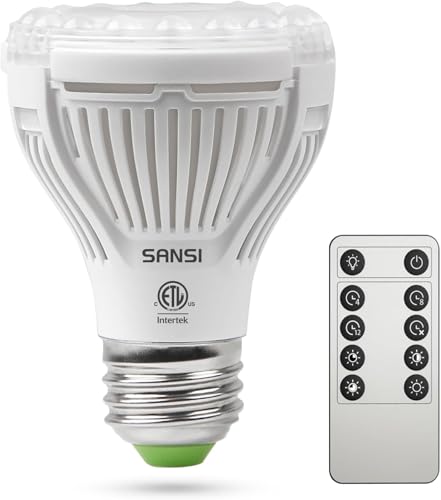 | Best Overall Performance | Timer Function: Timing function: 4H / 8H / 12H hours | Control Method: Remote control; no unplug/replug needed | Brightness/Intensity Adjustment: 4 dimming levels (25%, 50%, 75%, 100%) | VIEW ON AMAZON | Read Our Analysis |
| BN-LINK Indoor Digital Timer Outlet Dual Outlet |  | Dual Outlet Professional | Timer Function: Up to 8 on/off programs; as short as one minute | Control Method: Digital programmable display | Brightness/Intensity Adjustment: On/Off only | VIEW ON AMAZON | Read Our Analysis |
More Details on Our Top Picks
BN-LINK Indoor Mechanical Outlet Timer 2-Pack
Want a no-frills way to automate your grow lights without breaking the bank? The BN-LINK BN-D-60/U47 delivers exactly that. This 2-pack of mechanical timers lets you set up to 24 on/off cycles daily in 30-minute intervals, perfect for maintaining consistent light schedules your plants need. The 3-prong design fits standard outlets, and you’ll appreciate the simple pin system—pull pins up to turn off, press down to turn on. With a 15-amp rating and 1875-watt capacity, it handles most grow light setups reliably. At an affordable price point, you’re getting dependable automation without smart home complexity or subscription fees.
- Timer Function:24-hour mechanical timer; up to 24 on/off settings per day
- Control Method:Manual pin adjustment (UP/DOWN)
- Brightness/Intensity Adjustment:On/Off only
- Spectrum Options:Not applicable (outlet timer only)
- Adjustability:Not adjustable (compact outlet timer)
- Lifespan/Durability:Not specified
- Additional Feature:Up to 24 on/off settings daily
- Additional Feature:30-minute programmable intervals
- Additional Feature:2-pack for dual locations
Grow Lights for Indoor Plants with Adjustable Tripod Stand
If you’re juggling multiple plants across different growth stages, you’ll appreciate how this five-head grow light lets you customize each LED independently while adjusting the entire tripod from 15 to 63 inches tall. You’ll control three spectral modes—red+blue, white, or full spectrum—across 10 brightness levels using either the inline controller or wireless remote. The programmable auto on/off timer offers 4, 8, or 12-hour intervals, automating your plant care routine. Built with an aviation-grade heat sink and aluminum shell, this light delivers 50,000 hours of reliable performance. Its 360-degree goosenecks provide flexible positioning for any indoor space, from offices to greenhouses.
- Timer Function:Auto on/off with programmable intervals: 4H / 8H / 12H
- Control Method:Inline controller + RF wireless remote control (30 meters)
- Brightness/Intensity Adjustment:10 brightness levels (10%-100%)
- Spectrum Options:3 spectral modes: Red+Blue / White / White+Red+Blue
- Adjustability:Adjustable height 15″-63″; 360-degree goosenecks; independent head control
- Lifespan/Durability:50,000-hour lifespan; aviation-grade heat sink
- Additional Feature:5 independent LED heads
- Additional Feature:360-degree gooseneck adjustability
- Additional Feature:50,000-hour lifespan
Plant Grow Light Full Spectrum 48 LEDs (3-Pack)
Looking for a versatile grow light that won’t break the bank? This 48-LED full spectrum system delivers three lighting modes with 10 brightness levels you’ll control effortlessly. You’ll appreciate the adjustable spectrum options—white, warm white, red, or mixed—tailored to your plants’ needs. The built-in timer lets you set cycles of 3, 9, or 12 hours, automating daily on/off schedules. With its 90-degree rotatable pipe and adjustable height up to 26 inches, you’ll position it perfectly for any setup. The included stand ensures stability, while the compact design doubles as home décor. This three-pack offers exceptional value for indoor gardeners managing multiple plants simultaneously.
- Timer Function:Built-in timer with cycle options: 3H / 9H / 12H
- Control Method:Button controls on device
- Brightness/Intensity Adjustment:10 brightness levels (10%-100%)
- Spectrum Options:3 spectrum options: White / Warm White / Red; Mix Lighting
- Adjustability:Height adjustable up to 26 inches; 90-degree rotateable pipe
- Lifespan/Durability:Not specified
- Additional Feature:Soil insertion or stand mount
- Additional Feature:26-inch maximum height adjustment
- Additional Feature:90-degree rotateable pipe
SANSI Dimmable Full Spectrum Grow Light Bulb
The SANSI Dimmable Full Spectrum Grow Light Bulb’s remote-controlled timer makes it ideal for plant parents who can’t always be home to manually adjust their grow lights. You’ll appreciate the convenient 4, 8, and 12-hour timing presets paired with four dimming levels (25%, 50%, 75%, 100%), letting you customize light exposure without unplugging anything. This 10W PAR20 bulb delivers impressive performance with 97.91 μmol/s·m² PPFD at one foot, supporting everything from monsteras to orchids. Its full spectrum (400nm–780nm) promotes robust growth while consuming 93% less energy than traditional bulbs. With a 25,000-hour lifespan, ETL certification, and a five-year protection plan, you’re investing in reliable, long-term plant care.
- Timer Function:Timing function: 4H / 8H / 12H hours
- Control Method:Remote control; no unplug/replug needed
- Brightness/Intensity Adjustment:4 dimming levels (25%, 50%, 75%, 100%)
- Spectrum Options:Full spectrum 400nm-780nm
- Adjustability:PAR20 bulb with 60-degree beam; fixed orientation
- Lifespan/Durability:Up to 25,000-hour lifespan; ETL listed & CE certified
- Additional Feature:97.91 PPFD @ 1ft
- Additional Feature:93% energy savings vs traditional
- Additional Feature:5-year protection plan included
BN-LINK Indoor Digital Timer Outlet Dual Outlet
Want a reliable timer that won’t complicate your grow light setup? The BN-LINK Indoor Digital Timer Outlet delivers straightforward control with dual outlets and eight customizable on/off programs. You’ll appreciate its 7-day scheduling flexibility, allowing individual day settings or preset combinations. The 15A/1875W capacity handles most grow lights without issue. Its random vacation mode simulates occupancy when you’re away, while daylight savings adjustment keeps everything synchronized automatically. The backup battery preserves your settings during power outages, so you won’t lose your carefully programmed schedule. ETL-listed and built for safety, this timer offers reliable performance without unnecessary complexity.
- Timer Function:Up to 8 on/off programs; as short as one minute
- Control Method:Digital programmable display
- Brightness/Intensity Adjustment:On/Off only
- Spectrum Options:Not applicable (outlet timer only)
- Adjustability:Not adjustable (outlet timer only)
- Lifespan/Durability:Long-lasting backup battery; ETL listed
- Additional Feature:Random vacation mode feature
- Additional Feature:Dual outlet simultaneous control
- Additional Feature:Daylight savings mode support
Factors to Consider When Choosing Timer-Controlled Grow Lights
When you’re selecting timer-controlled grow lights, you’ll want to evaluate the light spectrum and wavelengths to match your plants’ growth stages, along with the brightness levels and intensity required for your specific setup. You should also examine the timer programming flexibility to ensure it accommodates your desired light schedules, while considering heat management and durability to protect your investment long-term. Finally, assess the adjustability and coverage area so the lights can effectively reach all your plants without requiring multiple units.
Light Spectrum And Wavelengths
Why does spectrum matter so much when you’re selecting a timer-controlled grow light? Different wavelengths directly impact your plants’ development. Blue light strengthens vegetative growth, while red light promotes flowering and fruiting. Full-spectrum lights mimic natural sunlight across 400–780 nm, enhancing overall photosynthesis and plant health.
You’ll want to consider your plants’ specific needs. If you’re growing seedlings or leafy greens, prioritize blue-rich spectra. For flowering plants, red-dominant options work better. Many quality timer-controlled grow lights offer selectable spectra—Red+Blue, White, or full-spectrum combinations—letting you tailor output to your growth phase.
Paired with adequate PPFD (photosynthetic photon flux density) measured in μmol/m²/s, proper wavelength distribution maximizes leaf development and crop yield in your indoor setup.
Brightness Levels And Intensity
Once you’ve matched your spectrum to your plants’ needs, brightness levels become your next consideration. You’ll find most timer-controlled grow lights offer adjustable brightness in fixed increments—typically 10% steps—allowing you to match intensity to your plants’ growth stages. Many models feature dimming presets like 25%, 50%, 75%, and 100% for precise control.
Pay attention to readouts measured in lumens or PAR values, as higher numbers indicate stronger intensity for photosynthesis. If you’re using multi-head setups, independent head control lets you optimize coverage across different plant zones efficiently.
Consider pairing your timer with dimming capabilities to gradually ramp intensity up or down, reducing plant shock during transitions between growth stages.
Timer Programming Flexibility
How you schedule your grow lights matters just as much as their intensity and spectrum. You’ll want devices offering 8–24 daily programs so you can craft sophisticated schedules tailored to your plants’ needs. Look for timers supporting repeat daily cycles—this ensures your programmed times recur automatically without daily reprogramming.
Check the minimum program interval; many timers accommodate 15–30 minute increments, letting you fine-tune light exposure precisely. If you’re managing multiple zones or heads, verify whether the timer allows independent control for separate outlets. This enables staggered lighting across different areas.
Finally, confirm the device has reliable power interruption backup or memory retention through a backup battery. This protects your programmed settings during outages, preventing disruptions to your cultivation schedule.
Heat Management And Durability
Beyond scheduling, you’ll need to contemplate what happens to your grow lights during those programmed cycles—particularly the heat they generate. Quality heat dissipation directly impacts your investment’s longevity and performance stability.
Look for grow lights featuring aviation-grade heat sinks and aluminum housings that actively manage thermal output. These materials prevent heat accumulation that degrades LED lifespan and causes thermal throttling, which reduces your PPFD consistency during operation.
Timer-controlled cycling naturally helps mitigate overheating by limiting continuous runtime to your specified intervals. Combined with robust cooling design, this feature keeps components operating safely without performance fluctuations.
Prioritize models offering 50,000+ hour lifespans—these typically incorporate optimized cooling solutions that maintain stable spectral performance and color rendering throughout extended daily use.
Adjustability And Coverage Area
As your plants grow and their light requirements shift, you’ll need grow lights that adapt to those changing conditions rather than remain fixed in position. Look for models featuring adjustable height and angle capabilities that match your plant canopy as it develops through different growth stages. Multi-head designs with independent controls let you customize light delivery for each plant, eliminating shadowed zones and maximizing photosynthetically active radiation (PAR) across your growing area.
Tripod or stand-based setups offer stable height ranges—typically 15″ to 63″—without requiring ceiling attachments. Goosenecks or flexible arms enable precise directional lighting. When combined with automated interval timings like 4H, 8H, or 12H settings, these adjustable systems deliver consistent coverage throughout plant cycles, reducing your need for constant manual repositioning.
Energy Efficiency And Wattage
While adjustable positioning ensures your plants receive light where they need it, you’ll also want to consider how much energy that light actually consumes. Compare wattage ratings across models, but don’t fixate on raw numbers alone—efficacy matters more. Look for lights delivering high lumens per watt, which means you’re getting maximum PAR output without excessive power draw.
LED-based grow lights typically outperform traditional bulbs, offering superior energy efficiency when paired with timers. Programmable intervals let you dial in precise ON-hours for your plant’s growth stage, eliminating wasted illumination during rest periods. If your light supports dimming, you can further tailor energy consumption to your specific needs. This combination of smart timing and efficient spectrum management significantly reduces your operational costs while maintaining optimal plant development.
Compatibility With Plant Types
How do you know if a grow light will actually support your plants? You’ll need to match the light spectrum to your specific species. Leafy greens thrive under blue-dominant spectra, while flowering and fruiting plants require red wavelengths. Look for full-spectrum options or adjustable modes offering red/blue combinations to accommodate your entire garden.
Beyond spectrum, consider your plants’ growth stages. Seedlings need shorter photoperiods with lower intensity, whereas mature plants demand longer daily cycles and higher PPFD levels. Timer-controlled systems let you program these varying intervals precisely.
Multi-head configurations also matter. Independent head control ensures even light distribution across different plant canopies, preventing the leggy growth that occurs when some areas receive inadequate illumination. This flexibility transforms your grow light into a truly customizable tool.
Installation And Setup Requirements
Before you invest in a timer-controlled grow light, you’ll want to verify that your electrical infrastructure can actually support it. Check your outlet type and voltage—most systems require 120V, 60 Hz with appropriate plug compatibility (2-prong or 3-prong). You’ll also need to confirm the timer’s control method: mechanical dial, digital programming, or app-based. Verify maximum on/off programs available daily.
Examine the timer’s power ratings carefully. Ensure both the timer and outlet can handle your grow light’s combined wattage and amperage without overloading circuits. Additionally, confirm whether your timer supports daily repeating schedules and clarify daylight saving time adjustment procedures.
Finally, check if your timer includes backup battery preservation to maintain programs during power outages—a critical feature protecting your growing schedule.
Frequently Asked Questions
How Long Do Timer-Controlled Grow Lights Typically Last Before Needing Replacement?
You’ll typically get 25,000 to 50,000 hours of use from quality timer-controlled grow lights before you’re replacing them. That’s roughly three to five years of continuous operation, depending on the bulb type and manufacturer specifications.
Can I Use Regular Outlet Timers With Any Type of Grow Light Bulb?
You can use regular outlet timers with most grow light bulbs, but you’ll want to check wattage compatibility first. High-wattage LEDs or HPS bulbs might exceed your timer’s capacity, so verify specifications before connecting.
What’s the Ideal Photoperiod for Different Stages of Plant Growth Indoors?
You’ll want 16-18 hours of light during the vegetative stage to promote leafy growth. Switch to 12 hours during flowering to trigger blooming. You can adjust based on your plant species’ specific needs.
Are Timer-Controlled Grow Lights Energy-Efficient Compared to Traditional Grow Light Setups?
You’ll find timer-controlled grow lights substantially more energy-efficient than traditional setups because they’re automatically optimized for specific photoperiods, reducing unnecessary operating hours and electrical waste while maintaining ideal growing conditions.
How Do I Prevent Heat Damage When Using Multiple Grow Lights in Small Spaces?
You’ll prevent heat damage by spacing lights adequately, installing ventilation fans, monitoring temperatures regularly, and using heat-dissipating reflectors. You can also raise fixtures higher and install timers to cycle lights off during peak heat hours.